
Prevention-First Zero Trust: Why Detect-and-Respond Is No Longer Enough
A Prevention-First Zero Trust approach to cybersecurity threats continues to evolve at an alarming pace. Unfortunately, many organizations still rely on outdated security models built around detection and response. While those strategies once provided acceptable protection, modern attacks now move too fast for reactive defenses alone.
Today, attackers use automation and artificial intelligence to compromise businesses within seconds. As a result, organizations can no longer depend solely on identifying threats after execution. Instead, companies must adopt a prevention-first Zero Trust strategy that blocks unauthorized activity before damage occurs.
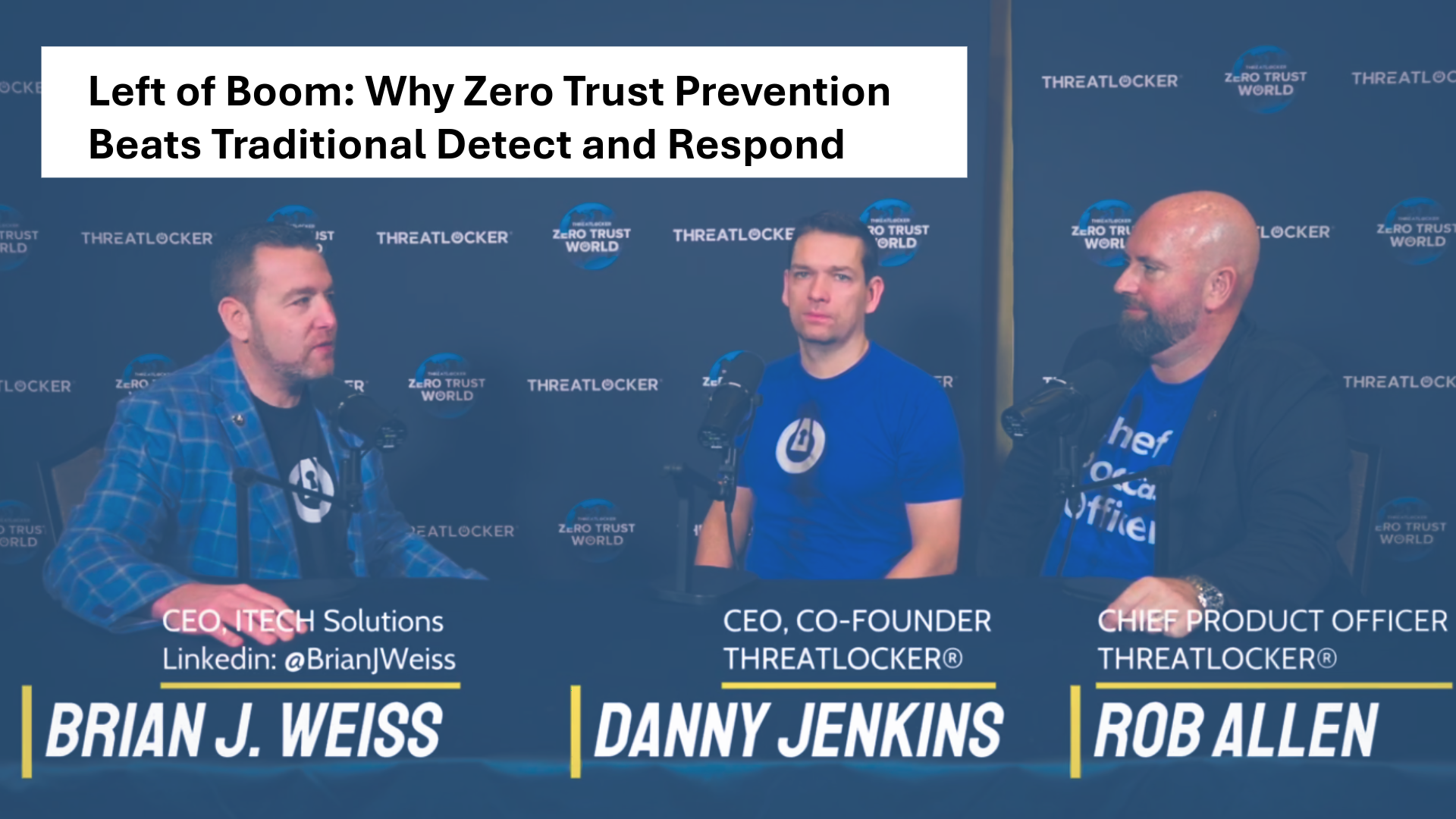
Recently, I had the opportunity to sit down with Danny Jenkins, CEO of ThreatLocker, and Rob Allen, Chief Product Officer of ThreatLocker, for a candid discussion about why ITECH Solutions standardized on a prevention-first cybersecurity approach. During the conversation, we explored why ThreatLocker, combined with Microsoft Defender, forms the foundation of our modern Zero Trust security model.
This conversation was not about marketing hype. Instead, it focused on real-world lessons learned while protecting organizations at scale and helping businesses reduce operational risk in meaningful ways.
Why Detect-and-Respond Is No Longer Enough
For years, cybersecurity strategies centered around identifying malicious behavior and responding quickly. Most security tools still operate under this philosophy today. However, the modern threat landscape exposes major weaknesses in that approach.
Attackers only need one successful opportunity to compromise an environment. Meanwhile, security teams must correctly identify and stop every threat. Unfortunately, that imbalance creates enormous pressure on IT and security operations teams.
Traditional security models also introduce several operational challenges, including:
- Excessive alert fatigue
- False positives that waste time
- Slow incident response
- Increased operational overhead
- Gaps caused by human error
Even highly skilled teams struggle to keep up. In many cases, mean-time-to-respond is measured in minutes while ransomware or credential theft can occur in seconds.
Because of this, organizations need a different strategy.
What a Prevention-First Zero Trust Model Looks Like
A prevention-first Zero Trust strategy fundamentally changes the security mindset. Rather than allowing activity first and investigating later, the goal becomes blocking anything unauthorized by default.
ThreatLocker supports this model by enforcing strict application control and Zero Trust principles.
Instead of chasing indicators of compromise, organizations define what should be allowed to run. Everything else gets denied automatically.
This approach dramatically reduces the attack surface before attackers ever gain a foothold.
Key elements of a prevention-first model include:
- Applications denied unless explicitly approved
- Ringfencing controls that limit application behavior
- Storage protection to stop ransomware encryption
- Least-privilege access enforcement
- Network and device trust validation
- Blocking unauthorized scripts and executables
As discussed during the podcast, trying to predict every new attack technique is a losing battle. Threat actors constantly evolve tactics faster than security teams can react.
However, when unknown software cannot execute in the first place, many attack methods become irrelevant.
That is the essence of true Zero Trust security.
Why ITECH Solutions Combines ThreatLocker with Microsoft Defender
At ITECH Solutions, we maintain a Defender-first security posture.
Microsoft Defender already provides strong foundational protection and is included within many Microsoft licensing tiers. When configured correctly, Defender delivers valuable endpoint detection, identity protection, and threat intelligence capabilities.
However, like most traditional Endpoint Detection and Response (EDR) platforms, Defender still relies heavily on detecting malicious behavior.
ThreatLocker fills the prevention gap.
By layering ThreatLocker alongside Microsoft Defender, organizations gain both visibility and prevention.
This combined approach helps organizations:
- Prevent unknown and zero-day threats from executing
- Reduce reliance on behavioral detection logic
- Compensate for user mistakes
- Strengthen Zero Trust enforcement
- Protect identities, applications, devices, and networks
- Improve operational security consistency
Most importantly, businesses maximize security investments they already own instead of endlessly purchasing overlapping tools.
Reducing Tool Sprawl and Security Complexity
Many organizations unknowingly create security complexity while trying to improve protection.
During assessments, we commonly see environments running:
- 10 to 15 separate security products
- Multiple endpoint agents
- Overlapping monitoring tools
- Numerous dashboards and portals
- Conflicting security policies
Over time, that complexity creates operational friction and blind spots.
Common consequences include:
- Increased licensing costs
- Configuration drift
- Slower troubleshooting
- More false positives
- Team burnout
- Reduced visibility
A prevention-first Zero Trust strategy simplifies security operations considerably.
Instead of constantly triaging alerts, security teams spend more time enforcing intentional controls.
As a result:
- Alert volume drops significantly
- Operational overhead decreases
- Smaller teams protect larger environments
- Incident response becomes more manageable
- Total cost of ownership improves
Security becomes both simpler and stronger simultaneously.
How Prevention-First Security Supports Fully Managed Clients
For fully managed IT and security clients, prevention-first Zero Trust delivers consistent protection without requiring large internal security teams.
At ITECH Solutions, we use this approach to:
- Standardize Zero Trust enforcement
- Reduce ransomware exposure
- Improve operational stability
- Minimize security firefighting
- Deliver continuous improvement
Many organizations simply want cybersecurity handled properly without managing dozens of tools internally. For those clients, our fully managed approach provides enterprise-grade security with reduced complexity.
Instead of constantly reacting to threats, businesses gain a stable security framework designed around prevention.
Helping CIOs and CISOs Through Co-Managed Security
Larger organizations often maintain internal IT and security teams. However, even mature teams face resource limitations, competing priorities, and organizational delays.
That is where co-managed security becomes valuable.
ITECH Solutions partners with CIOs, CISOs, and internal teams to accelerate Zero Trust maturity without disrupting operations.
Our co-managed model helps organizations:
- Design prevention-first Zero Trust strategies
- Validate security assumptions objectively
- Execute Proofs of Concept (POCs)
- Reduce deployment risk
- Optimize existing Microsoft investments
- Improve operational efficiency
Even when technical expertise exists internally, many initiatives stall because of approval processes or limited bandwidth.
We frequently help organizations move faster by managing architecture, validation, testing, and implementation efforts on their behalf.
That partnership reduces uncertainty while enabling leadership teams to make more confident security decisions.
A Strategic Partnership with ThreatLocker
Our relationship with ThreatLocker extends far beyond traditional product resale.
ITECH Solutions actively uses the full ThreatLocker platform internally while collaborating closely with the vendor to improve customer outcomes.
Our involvement includes:
- Serving on the ThreatLocker Partner Advisory Board
- Providing real-world operational feedback
- Helping influence roadmap discussions
- Assisting with feature prioritization
- Sharing insights from customer environments
That collaboration ensures our clients benefit from practical improvements shaped by real operational experience.
ThreatLocker’s commitment to prevention, partner collaboration, and solving real-world security challenges aligns directly with how we approach cybersecurity strategy.
Why Prevention-First Zero Trust Matters Now
Cybersecurity continues to grow more complex every year. Meanwhile, businesses face increasing pressure to reduce risk, control costs, and maintain operational resilience.
Unfortunately, adding more tools does not automatically improve security.
In many cases, complexity becomes the greatest vulnerability.
A prevention-first Zero Trust strategy changes that equation by focusing on control, simplicity, and intentional security enforcement.
Rather than chasing threats endlessly, organizations define what should happen inside their environments and block everything else.
That shift creates measurable benefits, including:
- Lower ransomware risk
- Reduced attack surfaces
- Improved operational efficiency
- Better security visibility
- Reduced alert fatigue
- Lower total cost of ownership
Most importantly, it allows organizations to regain confidence in their security posture.
Listen to the Full Podcast Conversation
If you want a deeper discussion on:
- Why detect-and-respond security struggles today
- How prevention-first Zero Trust works operationally
- Real-world examples of reduced alert fatigue
- Combining Microsoft Defender with ThreatLocker
- Simplifying security while reducing risk
I encourage you to listen to the full podcast episode featuring Danny Jenkins and Rob Allen from ThreatLocker.
Whether your organization is fully managed or co-managed, the conversation offers valuable insights into modern cybersecurity strategy and operational maturity,
Brian J. Weiss
Final Thoughts
At ITECH Solutions, we believe cybersecurity should reduce complexity, not increase it.
By aligning Microsoft Defender with ThreatLocker and embracing a prevention-first Zero Trust model, organizations can meaningfully reduce risk while simplifying operations.
Security should not rely on chasing attackers after compromise occurs. Instead, it should focus on preventing unauthorized activity from executing in the first place.
That philosophy drives how we protect our clients every day.
If your organization is evaluating Zero Trust, struggling with tool sprawl, or looking to mature security operations faster, we would welcome the conversation.
Fully Managed Zero Trust Security
If your organization prefers to outsource IT and security operations completely, we deliver a prevention-first Zero Trust strategy designed to simplify operations while reducing risk.
Our fully managed approach includes:
- Block-by-default application controls
- Microsoft Defender optimization
- ThreatLocker deployment and management
- Reduced tool sprawl
- Continuous security improvement
- Day-to-day operational oversight
Best for organizations seeking stronger security outcomes without expanding internal security teams.
👉 Contact ITECH Solutions to discuss fully managed Zero Trust security.
Co-Managed Security for CIOs and CISOs
If you already have internal IT or security teams, we partner with you to accelerate security maturity without disruption.
Our co-managed approach helps organizations:
- Build prevention-first Zero Trust roadmaps
- Maximize Microsoft security investments
- Reduce operational noise
- Validate architecture through POCs
- Accelerate implementation timelines
👉 Start a strategic Zero Trust conversation with ITECH Solutions today.